Locksmith Guide
Anti-Snap Locks Explained: TS007 Stars, Sold Secure and What to Fit
By Kenny, owner and locksmith at Open-in Security Services, Ickenham, working the same West London patch since 2006.
Published
The Short Answer
An anti-snap lock is a euro cylinder designed to survive lock snapping, an attack that breaks a standard cylinder at its screw hole in seconds on uPVC and composite doors. Under the TS007 Kitemark scheme a 3-star cylinder resists snapping on its own, while a 1-star cylinder needs a 2-star security handle; Sold Secure SS312 Diamond is the equivalent top grade. The marks are stamped on the cylinder face. Open-in Security Services fits anti-snap cylinders from £95.
Need it sorted, not read?
Ask about anti snap locks and get a fixed price on the call.
Call 07904 594452 WhatsApp insteadAn anti-snap lock is a euro cylinder built so that snapping it at the middle, the attack that defeats a standard cylinder in seconds, leaves the door locked. On the cylinder face, look for a BSI Kitemark with three stars (TS007 3-star) or the Sold Secure Diamond mark; a 1-star cylinder only reaches that level with a 2-star security handle over it. Open-in Security Services fits an anti-snap cylinder upgrade from £95, and on most uPVC and composite doors it is a swap of around 20 minutes.
What lock snapping is
Look at a euro cylinder end-on and you see a figure of eight: a round section that holds the pins and keyway, and a narrower body below it. At the centre of the body is the hole for the fixing screw that runs in from the door edge, and around that hole the metal is at its thinnest, which is the weak point.
The attack is crude. Whoever is doing it grips the part of the cylinder that stands proud of the handle, with mole grips or a purpose-made tool, and levers it up, down or sideways. A standard cylinder fractures at the screw hole and the outer half comes away in the hand. The cam that drives the multipoint lock is then exposed, and a screwdriver turns it.
From first grip to open door takes a matter of seconds, with little noise and no skill. It is mainly a uPVC and composite door problem because those doors run a euro cylinder as standard, but timber doors fitted with a euro sashlock are just as exposed, and so are garage side doors and outbuildings with the same lock.
The TS007 star system
TS007 is a Kitemark scheme for euro cylinders and the hardware around them, developed by the Door & Hardware Federation and the Glass and Glazing Federation and tested by BSI. It rates products with stars, and the aim is a door that adds up to three.
- 1-star cylinder. Tested against bumping, picking and drilling, with a measure of snap resistance, but designed to sit behind protective hardware rather than stand alone.
- 2-star handle or escutcheon. A security handle or shroud that covers the cylinder body so grips cannot get hold of it, tested for the same attacks.
- 3-star cylinder. Passes the full snapping test on its own, plus the bump, pick and drill tests, with no special handle needed.
So there are two valid routes to three-star protection: a 1-star cylinder fitted with a 2-star handle, or a 3-star cylinder in an ordinary handle. Both are accepted where an insurer or police security scheme asks for 3-star protection. The residential locksmith page lists the brands fitted under each route.
Sold Secure Diamond
Sold Secure is an independent test house, and its SS312 Diamond grade is the top rating it gives a euro cylinder. It was developed with a more demanding snapping test than the original TS007 scheme. Insurers and police security guidance accept either, and the better cylinders hold both marks.
How to tell if your cylinder is anti-snap
Start with the outside face of the cylinder, the ring of metal around the keyway. An anti-snap cylinder usually shows some of the following:
- A BSI Kitemark, the heart-shaped symbol, with one or three small stars next to it.
- The letters TS007, sometimes with the star count written out.
- A Sold Secure Diamond mark.
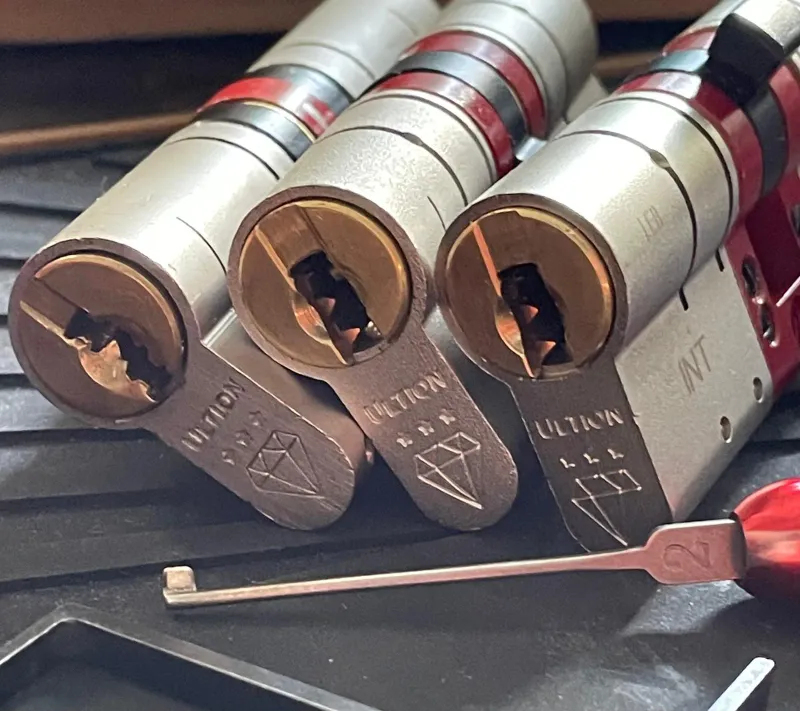
- A brand and range name known for anti-snap work: Ultion, Mul-T-Lock, Yale Platinum, ERA Fortress or Winkhaus.
Brand alone is not enough. Yale, for instance, makes standard cylinders as well as Platinum 3-star ones, so look for the range name and the stars together. A plain brass or nickel cylinder that shows only a maker’s name, or nothing at all, is almost certainly standard.
The other tell is inside the cylinder rather than on its face. Anti-snap cylinders have sacrificial cut lines: deliberate grooves in the body, outboard of the cam, so a snap breaks off a stub with nothing behind it. The cam and the rest of the mechanism stay in the door, still locked.
Some designs go further; Ultion, for example, has a hidden pin that locks the cylinder down entirely when an attack is detected. The cut lines are visible once the cylinder is out of the door, which you will be doing to measure it anyway.
How to measure a euro cylinder
- Open the door and find the retaining screw on the door edge, in line with the cylinder and usually just below the latch. Undo it.
- Put the key in and turn it 10 to 15 degrees either way, until the cam lines up with the body, then pull the cylinder out by the key.
- Find the centre of the fixing screw hole. Measure from that centre to the outside end, then from the centre to the inside end, in millimetres.
- Write the two figures down as outside/inside, for example 35/45 or 40/50. Sizes run in 5 mm steps and most house doors fall between 70 mm and 100 mm overall. If there is a thumbturn, note which side it is on.
- Refit the cylinder, turn the key back to centre and replace the retaining screw.
With the cylinder in place, check the overhang: its outside face should sit flush with the handle plate or protrude no more than 3 mm. Anything beyond that is a handhold for grips. The ratings assume a correctly sized cylinder, so a 3-star unit that is too long for the door does not deliver what it promises. Open-in Security Services sizes every cylinder to the door.
Cost and time on site
An anti-snap cylinder upgrade with Open-in Security Services is from £95, and a euro cylinder replacement, where a standard cylinder is all that is needed, is from £65. These are starting points; the exact fixed price is confirmed by phone before the visit, and no call-out fee applies. Every starting price is on the pricing page.
On most uPVC and composite doors the job is a straight swap of around 20 minutes, with no change to the door, the handle or the multipoint strip. It takes longer if the cylinder is an unusual size that has to be ordered in, or if the handle is being changed at the same time. If the door itself lifts hard or the handle has gone floppy, that is a separate fault in the multipoint gearbox, covered on the uPVC door repair page, and it can be sorted in the same visit.
When a security handle is the better route
A 3-star cylinder is the simpler answer on most doors, but there are cases where a 2-star handle earns its place:
- You already have a 1-star cylinder. Adding a 2-star handle takes the door to three stars without throwing away a sound cylinder or changing the keys.
- An awkward cylinder size. Offset or very short cylinders are not always available in a 3-star version, so a 1-star cylinder under a 2-star handle is the practical route.
- A door that has been attacked before. A security handle covers the cylinder body and the fixing screws, adds drilling resistance across the plate, and pairs well with a 3-star cylinder for a belt-and-braces door.
- A tired or cracked handle. If the handle needs replacing anyway, a 2-star one costs little more than a plain one. Handle replacement is from £55.
Keyed-alike sets
If the front, back and side doors all take euro cylinders, they can be supplied keyed alike so one key does the lot. A keyed-alike set is from £95. Bear in mind that Ultion, Mul-T-Lock and similar cylinders use restricted keys, so spares cannot be copied at a shoe-repair counter; the key cutting page explains how restricted keys are cut, from £25 each. For a mixed house, say a timber front door and a composite back door, the lock rekey and replacement page covers the options.
Standard versus 1-star versus 3-star
| Standard euro cylinder | TS007 1-star cylinder | TS007 3-star or SS312 Diamond | |
|---|---|---|---|
| Snapping | Breaks at the screw hole in seconds | Some resistance; intended for use behind a 2-star handle | Passes the snap test on its own, with sacrificial cut lines |
| Bumping and picking | Little or none | Tested | Tested |
| Drilling | Little or none | Hardened anti-drill pins | Hardened anti-drill pins |
| Markings on the face | Maker’s name or nothing | Kitemark with one star | Kitemark with three stars, or the Diamond mark |
| Meets an insurer’s anti-snap wording | No | Only with a 2-star handle | Yes |
| Open-in Security Services price | Euro cylinder replacement, from £65 | Quoted by phone with the handle | Anti-snap cylinder upgrade, from £95 |
Anti-snap upgrades across West London
Open-in Security Services is based in Ickenham and fits anti-snap cylinders across the surrounding area, including Pinner and Northwood. If you cannot tell what is on your door, send a photo of the cylinder face by WhatsApp or ring 07904 594452, and the locksmith will say whether it is worth changing. If a cylinder has already been snapped and you cannot get in, the emergency lockout page covers what happens next.
Sources
- Door & Hardware Federation, TS007 Kitemark standard for cylinders and security hardware (the 1-star, 2-star and 3-star scheme): dhfonline.org.uk
- Sold Secure, independent attack testing behind the Diamond, Gold, Silver and Bronze cylinder grades: soldsecure.com
- BSI, the Kitemark scheme under which TS007 cylinders are certified: bsigroup.com
- Secured by Design, police guidance on lock snapping and approved cylinder products: securedbydesign.com
FAQ
Anti snap locks: Quick Answers
How do I know if my lock is anti-snap?
Look at the face of the cylinder around the keyway. An anti-snap cylinder carries a BSI Kitemark with one or three stars, the letters TS007, or a Sold Secure Diamond mark, often with a range name such as Ultion, Mul-T-Lock, Yale Platinum, ERA Fortress or Winkhaus. A plain brass cylinder showing only a maker's name is almost certainly standard.
What does TS007 3-star mean?
TS007 is the Kitemark scheme for euro cylinders and the hardware around them. A 3-star cylinder has passed snapping, bumping, picking and drilling tests on its own. A 1-star cylinder reaches the same three-star level only when fitted with a 2-star security handle or escutcheon that shields the cylinder from grips.
Is Sold Secure Diamond better than TS007 3-star?
They are two routes to the same result. Sold Secure SS312 Diamond is the top cylinder grade from the Sold Secure test house, developed with a more demanding snapping test than the original TS007 scheme. Insurers and police security guidance accept either, and cylinders such as Ultion hold both marks.
How much does an anti-snap lock cost to fit?
Open-in Security Services fits an anti-snap cylinder upgrade from £95, and a standard euro cylinder replacement from £65. The fixed price is agreed by phone before the visit, there is no call-out fee, and a straight swap on most uPVC or composite doors takes around 20 minutes.
How do I measure a euro cylinder?
Remove the retaining screw on the door edge, turn the key slightly and slide the cylinder out. Measure from the centre of the fixing screw hole to each end in millimetres: those two figures, such as 35/45, are the size. Once refitted, the outside face should sit within 3 mm of the handle plate.