Locksmith Guide
Do You Need BS3621 Locks for Home Insurance? How to Check Your Doors
By Kenny, owner and locksmith at Open-in Security Services, Ickenham, working the same West London patch since 2006.
Published
The Short Answer
Most UK home insurance policies expect wooden final exit doors to have a five-lever mortice deadlock conforming to BS3621, identified by the BSI Kitemark and the number BS3621 stamped on the faceplate in the door edge. uPVC and composite doors are covered by different wording, usually multipoint locking with a TS007 3-star or Sold Secure Diamond cylinder. A non-compliant door can lead to a theft claim being reduced or refused. Open-in Security Services fits BS3621 deadlocks from £120.
Need it sorted, not read?
Ask about BS3621 locks home insurance and get a fixed price on the call.
Call 07904 594452 WhatsApp insteadFor most UK home insurance policies, yes: if your final exit door is wooden, the insurer expects a mortice deadlock with at least five levers that conforms to BS3621, and the fastest way to check is the Kitemark stamped into the faceplate on the door edge. uPVC and composite doors are judged differently, with policies looking for multipoint locking and, increasingly, a TS007 3-star or Sold Secure Diamond cylinder. Open-in Security Services fits a BS3621 mortice deadlock from £120, and the check below takes about two minutes.
What BS3621 actually is
BS3621 is the British Standard for thief-resistant lock assemblies that are operated by a key from both sides of the door. It is a performance standard, not a design: a manufacturer submits a lock, a test house attacks it in set ways, and only a lock that survives every test can carry the mark.
To pass, a lever lock needs at least five levers and a minimum of 1,000 key differs. It also needs hardened steel plates against drilling, a bolt that resists sawing and throws at least 20 mm into a boxed steel keep, and enough resistance to picking and forcing to pass. The current edition of the standard was published in 2017; locks tested to earlier editions still carry the mark and are not normally questioned.
A lock that has passed carries the BSI Kitemark, a heart-shaped symbol, alongside the number BS3621 on the faceplate. Plenty of five-lever locks are sold without that marking, and an insurer that names BS3621 will not accept an untested lock however many levers it has.
BS8621 and BS10621: the sister standards
BS8621 puts a lock through the same attack tests but with keyless egress: a thumbturn inside, so you can leave without finding a key. It suits flats, shared houses and any door on an escape route. BS10621 is the dual-mode version. The thumbturn works normally while someone is home, and the lock can be deadlocked from outside with the key so the turn is disabled while the property is empty.
If your wording says “BS3621 or equivalent”, either sister standard normally satisfies it. If it names BS3621 alone and you live in a flat, ask the insurer, because a key-both-sides deadlock on a flat entrance door can conflict with the building’s fire strategy.
How to check your own lock in two minutes
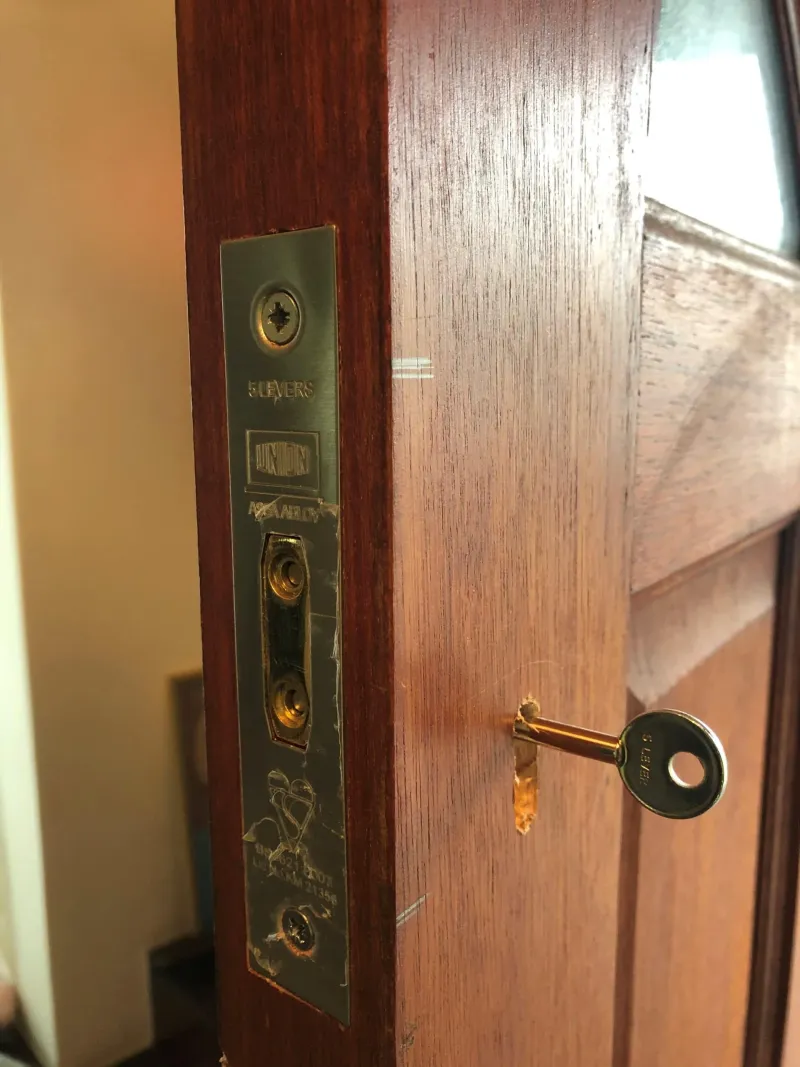
- Open the door and look at the edge. The metal strip the bolt comes through is the faceplate. A tested lock has the Kitemark and BS3621 (or BS8621 or BS10621) stamped into it. Some faceplates show BS EN 12209 instead: that is a general European lock standard, not a thief-resistance grade, and it does not satisfy a BS3621 clause.
- Look at the key. A five-lever key has a bigger bit with five stepped cuts along it; a three-lever key is smaller and plainer. The key is supporting evidence only; it does not prove a Kitemark.
- With the door open, turn the key fully. The deadbolt should throw close to 20 mm. A stubby bolt points to an older or lighter lock.
- Look at the keep in the frame. A BS lock is normally paired with a boxed keep, a steel enclosure the bolt sits inside, rather than a flat plate with a slot.
- Check any other lock on the door. A rim night latch made to BS3621 carries the same Kitemark on its case.
If the faceplate has been painted over, scrape a small patch clear with a blade before you decide. If you find no Kitemark at all, treat the lock as non-compliant; the residential locksmith page covers what a replacement involves.
What the insurer’s security endorsement says
Policies that include a minimum security condition tend to use similar language. In outline, it asks for:
- final exit doors fitted with a mortice deadlock of at least five levers conforming to BS3621, or a rim automatic deadlatch with a key-locking handle to the same standard;
- other external doors secured by the same type of deadlock or by key-operated bolts at top and bottom;
- sliding patio doors fitted with key-operated locks and, in some wordings, an anti-lift device;
- all accessible windows fitted with key-operated locks;
- all of those locks in use whenever the home is empty, and at night.
This is a condition of cover, not advice. If a burglar gets in through a door that falls short of the clause, the insurer can argue the condition was not met and reduce or decline the theft part of the claim. Some policies only apply the condition when there was no forced entry; others apply it regardless, so read your own schedule.
There is a second risk: if you said yes to a BS3621 question at the quote stage, a wrong answer can be treated as a misrepresentation. The exact clause varies between insurers, which is why the two-minute check matters.
Wooden doors versus uPVC and composite
BS3621 is written around key-operated mortice and rim locks in timber doors. A uPVC or composite door works differently: a multipoint strip runs down the edge with hooks, rollers or bolts, and a euro-profile cylinder drives the lot. There is no BS3621 mortice deadlock for that door, and cutting one in would weaken it. Insurers know this, so the clause for these doors normally asks for a multipoint locking system, and the sensible standard for the cylinder is TS007 3-star or Sold Secure Diamond, or a 1-star cylinder under a 2-star security handle.
Lock snapping targets the euro cylinder in exactly these doors, so an anti-snap cylinder is doing on a composite door what a BS3621 deadlock does on a timber one. If your uPVC door also lifts hard to lock, the uPVC door repair page explains the multipoint gearbox behind it.
Night latches to BS3621
A conventional night latch, the spring-latch type most people call a Yale, is not a deadlock: it can be slipped, or opened through the letterbox, and insurers do not count it. A night latch made to BS3621 is different. It deadlocks itself when the door closes, has a key-locking handle inside, and carries the Kitemark. On an older timber door that runs a night latch and a separate mortice deadlock, the deadlock is the lock the policy cares about, but a BS3621 night latch on its own can satisfy some wordings.
Window locks
The window clause usually covers any window a person could reach without a ladder: ground floor, plus anything over a flat roof, porch or balcony. Modern uPVC windows come with key-locking handles that meet it; older timber casements and sash windows need surface-mounted key locks or sash stops added, with the keys kept away from the glass.
Door type, what the policy expects, what gets fitted
| Door | What the policy usually expects | What Open-in Security Services fits |
|---|---|---|
| Timber final exit door | Five-lever mortice deadlock to BS3621, or a BS3621 rim night latch | Kitemarked BS3621 mortice deadlock, from £120 |
| Timber side or back door | Same deadlock, or key-operated bolts top and bottom | BS3621 deadlock or key-operated bolts |
| Flat entrance or escape-route door | BS8621 or BS10621 with an inside thumbturn | Kitemarked thumbturn deadlock to the sister standard |
| uPVC or composite door | Multipoint locking; TS007 3-star or Sold Secure Diamond cylinder increasingly named | Anti-snap cylinder upgrade, from £95 |
| Accessible windows | Key-operated window locks | Window locks on request, quoted by phone |
What it costs
Open-in Security Services fits a BS3621 mortice deadlock from £120. Where a euro cylinder is the right answer instead, an anti-snap cylinder upgrade is from £95 and a euro cylinder replacement from £65. If you want front and back doors on one key at the same time, a keyed-alike set is from £95. Those figures are starting points, listed in full on the pricing page: the exact fixed price is agreed by phone before any work starts, and there is no call-out fee.
On a timber door that already holds a mortice lock, the new deadlock often drops into the existing pocket. Where there is no existing pocket, or a slim lock has to give way to a full-size case, cutting one takes longer and is quoted before the visit. If your keys are unaccounted for as well, a rekey or cylinder replacement can be done on the same visit.
What to tell your insurer after fitting
- Keep the invoice. It should state the standard fitted, BS3621 or BS8621, and the door it went on.
- Photograph the faceplate with the Kitemark visible and keep it with your policy documents.
- Tell the insurer, by phone or online, so the security answer on your record matches the door.
- Ask whether the policy offers a discount for approved locks; some do.
- Use the locks. Almost every wording requires them to be engaged when the house is empty and at night.
Getting it done in West London
Open-in Security Services works from Ickenham and covers neighbouring areas such as Ruislip and the wider West London patch. If you would rather not do the check yourself, call 07904 594452 or send a photo of the faceplate by WhatsApp, and the locksmith will say whether anything needs changing. If you are locked out rather than upgrading, the emergency lockout page covers that instead.
Sources
- BSI, publisher of BS 3621 (thief-resistant lock assemblies, key egress) and the Kitemark scheme: bsigroup.com
- Association of British Insurers, guidance on home security and policy conditions: abi.org.uk
- Secured by Design, police-backed door and lock security standards: securedbydesign.com
- Citizens Advice, what to do if an insurer rejects a claim: citizensadvice.org.uk
FAQ
BS3621 locks home insurance: Quick Answers
Do I need BS3621 locks for home insurance?
Most UK home insurance policies with a security condition expect a five-lever mortice deadlock to BS3621 on wooden final exit doors. It is not a legal requirement, but if your policy names the standard and your door falls short, a theft claim can be reduced or refused. uPVC and composite doors are usually covered by different wording.
How do I tell if my lock is BS3621?
Open the door and look at the metal faceplate in the door edge. A compliant lock has the BSI Kitemark, a heart-shaped symbol, and the number BS3621 stamped into it. A five-lever key and a bolt that throws about 20 mm support the finding, but only the stamped marking confirms it.
Does BS3621 apply to uPVC or composite doors?
No. BS3621 is written for key-operated mortice and rim locks, which sit in timber doors. uPVC and composite doors use a multipoint lock driven by a euro cylinder, so insurers usually ask for multipoint locking and, increasingly, a TS007 3-star or Sold Secure Diamond anti-snap cylinder instead.
What is the difference between BS3621 and BS8621?
Both pass the same thief-resistance tests. BS3621 locks need a key on both sides, while BS8621 locks have a thumbturn inside so you can leave without a key, which suits flats and doors on an escape route. BS10621 combines the two, letting you disable the thumbturn from outside with the key.
How much does it cost to fit a BS3621 lock?
Open-in Security Services fits a BS3621 mortice deadlock from £120, with the exact fixed price agreed by phone before the visit and no call-out fee. If the door already has a mortice lock the new one often uses the same pocket; where a new pocket has to be cut the job takes longer, but the price is confirmed first.