Locksmith Guide
Landlord Lock Changes: Between Tenancies, HMOs and Lost Keys
By Kenny, owner and locksmith at Open-in Security Services, Ickenham, working the same West London patch since 2006.
Published
The Short Answer
In England there is no blanket legal duty for a landlord to change the locks between tenancies, but it is strongly advised because old keys may still be in circulation. A cylinder rekey costs from £45 and a replacement from £65 through Open-in Security Services. If keys are not returned, the reasonable cost can usually be deducted from the deposit with a receipt. HMO bedroom doors need a thumbturn inside so no one needs a key to get out.
Need it sorted, not read?
Ask about landlord lock change between tenants and get a fixed price on the call.
Call 07904 594452 WhatsApp insteadThere is no blanket legal requirement in England for a landlord to change the locks between tenancies, but it is strongly advised, because you cannot know how many copies of the old key exist. A cylinder rekey from £45 or a replacement from £65 closes that gap in a single visit. If keys were not returned, the reasonable cost can usually be deducted from the deposit, provided you keep the receipt.
Do landlords have to change locks between tenants?
In England there is no general statute that obliges a private landlord to fit new locks every time a tenant moves out. What the law does expect is that the property is secure and that the landlord takes reasonable steps to protect the incoming tenant. A previous occupier, their partner, a cleaner or a builder may all hold a working key, and if one of them lets themselves in, “we never changed the locks” is a poor defence.
Selective licensing schemes, HMO licence conditions and some letting-agent terms go further and may set specific requirements, so check the tenancy agreement and any licence before deciding. Where nothing is stipulated, treat a lock change as routine turnover maintenance, like testing the smoke alarms.
Keys not returned: what you can deduct
The tenancy agreement normally requires every key to be handed back at the end of the term. When a full set is not returned, the landlord is generally entitled to claim the reasonable cost of restoring security from the deposit. “Reasonable” is the operative word: a rekey or cylinder swap is defensible, whereas an upgrade to high-security locks across the whole house is not, unless the tenant agreed to it.
To make a deduction stick, keep the check-in inventory listing how many keys were issued, the check-out record showing how many came back, and an itemised locksmith receipt. Deposit protection schemes decide disputes on paper, and the landlord who can produce all three usually wins.
Rekey, replace or key alike?
| Option | What changes | Starting price | Best for |
|---|---|---|---|
| Cylinder rekey | Pins inside the existing cylinder are reset so old keys stop working | from £45 | Sound lock, keys unaccounted for |
| Euro cylinder replacement | New cylinder and a fresh set of keys | from £65 | Worn lock, or a straightforward tenancy change |
| Anti-snap cylinder upgrade | Replacement with a TS007 3-star cylinder | from £95 | Insurance compliance on uPVC and composite doors |
| Keyed-alike set | Several cylinders matched so one key opens them all | from £95 | Front, back and side doors on a single key |
| BS3621 mortice deadlock | Kitemarked five-lever lock fitted to a timber door | from £120 | Insurance compliance on wooden final exit doors |
For most lettings, a rekey is the cheapest way to void old keys, and a fresh cylinder is only marginally more. Keying the doors alike means the tenant is issued one key instead of three, which reduces the number that can be lost. The lock rekey and replacement service covers every option in the table.
HMO door locks
Houses in multiple occupation carry two extra concerns: each bedroom is a separate secure space, and the escape route has to work in a fire for people who may not know the building well.
Bedroom doors
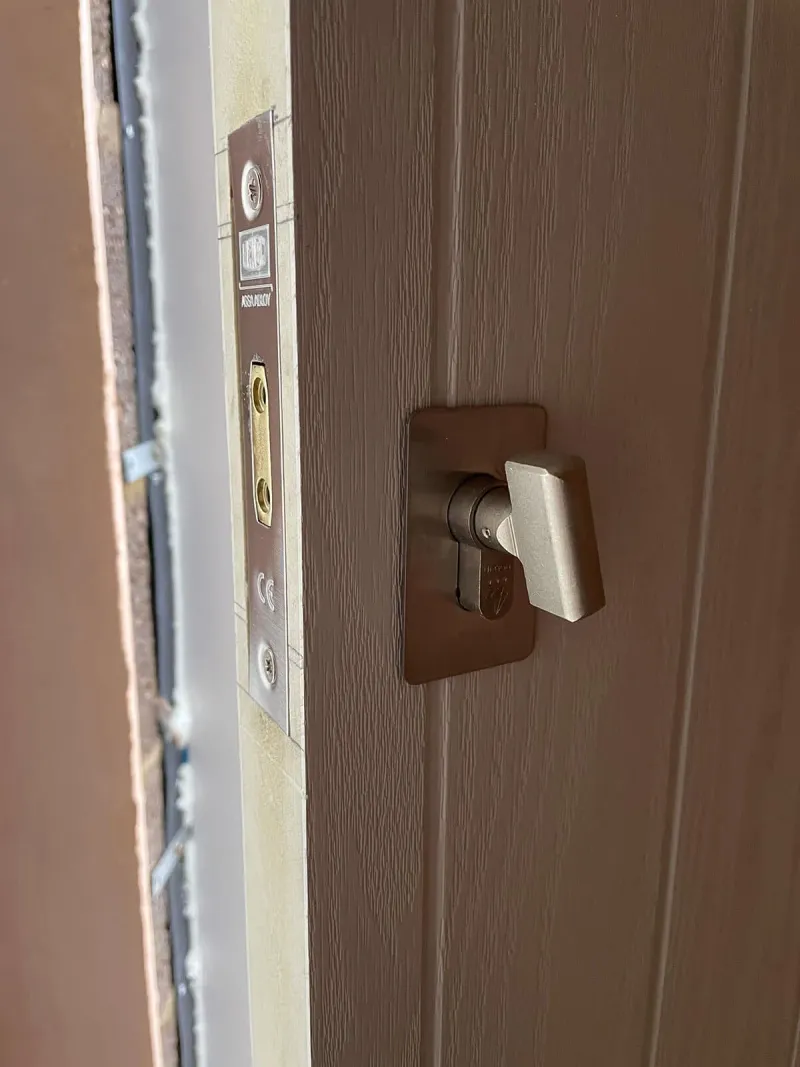
Each lockable bedroom door should have a lock that lets the occupant leave without a key. A thumbturn on the inside, with a key cylinder outside, is the standard answer. Locks that need a key from both sides, or bolts that could trap someone in, should be taken off. Licence conditions from your local authority may state precisely what is acceptable, so read them before buying hardware.
Fire door hardware
Bedroom doors in most licensed HMOs are fire doors, and the lock is part of that door. The self-closer, the intumescent strips and the latch all have to work together, so a badly fitted lock, or a closer disconnected because a tenant found it annoying, undermines the whole assembly. Check that each door closes and latches on its own at every turnover.
Key control
In a five-bedroom HMO with a shared front door, one lost keyring can compromise every lock in the house. Keeping bedroom cylinders separate from the front door, and rekeying only the affected door when a key goes missing, keeps each loss cheap. A record of which keys went to whom, updated at every change of occupant, shows exactly what needs changing.
Restricted keys and master key systems
Standard keys can be copied at any high-street kiosk for a few pounds, which means a departing tenant may have had spares cut that never appear on your inventory. Restricted or patented keys can only be cut on the authority of the registered keyholder, from £25 per key through the mobile key cutting service. For a landlord, that turns “how many copies exist” from a guess into a known number.
For a portfolio of properties or a large HMO, a master key system gives the landlord or agent a single key for the whole building, with each tenant holding a key that works nowhere but their own door. Systems start from £250 through the commercial locksmith service and can be extended as properties are added. The same approach suits agents managing dozens of flats across Harrow and Uxbridge.
When a tenant is locked out
Who pays depends on why the tenant is outside. If the lock has failed, the door has dropped or the mechanism has broken, that is a repair and normally the landlord’s responsibility. If the tenant has lost keys or shut the door with them inside, most tenancy agreements place the cost on the tenant, and it is worth having that clause spelled out clearly at sign-up.
Out-of-hours visits cost more, so a tenant ringing at midnight over a lost key should expect the evening rate. Open-in Security Services charges from £85 for a daytime non-destructive entry and from £110 in the evening or overnight, with no call-out fee. Before opening a door, the locksmith will ask for proof that the person requesting entry is entitled to be there, so tenants should have ID and something showing the address ready. The emergency lockout service sets out what to expect.
Tenancy-turnover lock checklist
The order of work on turnover day
- Count the keys against the check-in inventory before signing off the check-out.
- Note any lock that is stiff, loose or damaged during the inspection itself, not afterwards.
- Decide per door whether a rekey, a replacement or an upgrade is needed.
- Book the locksmith for the same day as the check-out, so the property never sits with unknown keys in circulation.
- Photograph the new hardware and file the receipt with the tenancy paperwork.
- Issue the new keys to the incoming tenant against a signed record.
Door-by-door checks
| Door or item | What to check | Action if a key is missing or the lock is worn |
|---|---|---|
| Front door | Cylinder or mortice turns smoothly, all keys returned | Rekey or replace the cylinder; fit BS3621 or TS007 3-star if the policy requires it |
| Back door | Same as the front, plus any bolts or night latch | Rekey, or key alike with the front door |
| Patio or French doors | Multipoint throws fully, cylinder not stiff | Replace the cylinder; adjust or repair the multipoint if it drags |
| Garage | Up-and-over lock, side-door lock, any padlock | Replace the lock or padlock; rekey if it shares a key with the house |
| Post box | Communal or individual box lock, key present | Replace the cam lock; they are inexpensive and often forgotten |
| Meter cupboard | Utility key or standard lock present | Replace the utility lock; agree who holds the key |
| Window keys | One key per lockable window, all present | Replace the window keys, or the locks if the pattern is unknown |
| Key safe | Code changed since the last occupant | Change the code at every turnover; replace the unit if the mechanism is loose |
Insurance wording for let properties
Landlord insurance policies usually carry the same minimum security conditions as owner-occupier cover, and a theft claim can be reduced or declined if the locks fall short. On timber final exit doors, the common requirement is a five-lever mortice deadlock made to BS3621. On uPVC and composite doors with a euro cylinder, insurers increasingly ask for an anti-snap cylinder rated TS007 3-star, or the alternative route of a 1-star cylinder behind a 2-star handle.
Read the wording rather than assuming, then match the hardware to it. The residential locksmith service fits both standards using hardware from Ultion, Mul-T-Lock, Yale, ERA, Winkhaus and Fullex, and the receipt states the standard fitted so it can be filed against the policy.
Working with landlords and agents across West London
Open-in Security Services has been based in Ickenham since 2006 and handles turnover lock work for landlords, letting agents and block managers across West London, from Hillingdon out to Harrow. Cylinder swaps and rekeys are done the same day where possible, so a property checked out in the morning can be relet with new keys by the afternoon. Every job is carried out by the same DBS-checked locksmith, comes with an itemised receipt, and is priced by phone before the visit, with no call-out fee.
For agents with several properties, keyed-alike sets, restricted keys and master systems can be planned across the portfolio rather than door by door. The pricing page lists the starting points for every job above, and a call to 07904 594452 gets a fixed figure for a specific property.
FAQ
Landlord lock change between tenants: Quick Answers
Do landlords have to change the locks between tenants in England?
There is no blanket legal duty in England to change locks at every tenancy change, but it is strongly advised because unreturned or copied keys may still open the door. Some HMO licence conditions and letting agreements do require it, so check the tenancy agreement and any licence before deciding.
A tenant did not return the keys. Can I deduct the lock change from the deposit?
Usually yes, as a reasonable cost of restoring security. Keep the check-in record showing keys issued, the check-out record showing what came back, and an itemised locksmith receipt. A rekey from £45 or cylinder replacement from £65 is defensible; a full security upgrade charged to the tenant generally is not.
What locks do HMO bedroom doors need?
Each bedroom door should be lockable from outside with a key and openable from inside without one, which is why a thumbturn cylinder is the usual fitting. Bedroom doors are normally fire doors, so the closer and latch must keep working with the new lock. Check your local authority's licence conditions for specifics.
Who pays when a tenant is locked out?
If the lock or door mechanism has failed, that is a repair and normally the landlord's cost. If the tenant has lost keys or locked themselves out, most tenancy agreements make the tenant responsible. Open-in Security Services charges from £85 for daytime entry and from £110 in the evening, with no call-out fee.
Should I rekey or replace the locks on a rental property?
Rekey when the lock is in good order and you only need old keys to stop working, from £45. Replace when the cylinder is worn or you want to step up to an anti-snap or BS3621 standard, from £65. A keyed-alike set from £95 puts several doors on one key.